|
One evolutionist, Kevin Kelly, editor of Wired magazine and director of the All Species Foundation,
said that:
"Despite a close watch, we have witnessed no new species emerge in the wild in recorded history.
Also, most remarkably, we have seen no new animal species emerge in domestic breeding. That
includes no new species of fruit flies in hundreds of millions of generations in fruit fly studies, where
both soft and harsh pressures have been deliberately applied to the fly populations to induce
speciation... In the wild, in breeding, and in artificial life, we see the emergence of variation. But by
the absence of greater change, we also clearly see that the limits of variation appear to be narrowly
bounded, and often bounded within species."
A decrease in information is observed in genetics: information is lost through generations. Evolution
requires an increase in information, this is not observed. There are two processes that can cause a
loss of information: Natural Selection makes gene variants more common or less common depending
on their reproductive success, whereas Genetic Drift is a process of random loss of information
within a reproducing population that may be beneficial, neutral, or detrimental. For example,
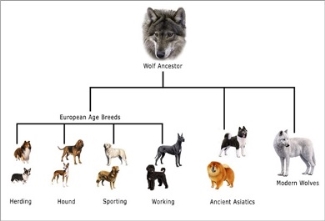
Dogs with "medium" length hair can produce dogs with long, medium or short hair. Two dogs with
short hair can only produce dogs with short hair. This may well be described as Natural Selection,
as dogs adapt to different climates.
Human's ear lobes are either attached or detached. If two people with attached ear lobes have
children, they will also have attached ear lobes. This doesn't really serve any purpose, so can be
described as Genetic Drift.
An additional complication is "dormant genes", where a trait can remain dormant (hidden) and skip a
generation, such as hair colour. However, if the gene is not passed on then the information is lost.
Information is passed down through generations, so it can be used to trace backwards to ancestors.
A genetic marker is a specific gene or DNA sequence with a known location on a chromosome that
can be used to identify cells, individuals or species.
Some look at genetic markers and conclude that this indicates that there was a common ancestor for
all primates - this is a big step of faith.
Others look at genetic markers and conclude that this indicates that there is a common Creator -
this
is a much smaller step of faith.
In human genetics, "Y-chromosomal Adam" is the nick-name given to the most recent common
ancestor from whom all living men are supposed to be descended from, tracing back along the
paternal lines of their family tree. Studies of people groups from all over the world have indicated that
all males have a common ancestor. Similarly, "Mitochondrial Eve" is the nick-name given to the most
recent common ancestor from whom all living humans are alleged to be descended from. Passed
down from mother to offspring, all mitochondrial DNA in every living person is directly descended from
hers.
However, it isn't quite as simple as that. There are some patterns and inferences that can be made,
but nothing as sweeping as DNA studies conclude "all living men / humans" are related. The study
into Mitochondrial Eve has been discredited by many leading Scientists as biased and unscientific.
In fact, Mark Stoneking, from the team that repeated the study in 1992, said in a letter to Science
magazine that the "African Eve" thesis was untenable, because it was clear that in all respects the
study had been aimed towards the desired result.
|

 Previous
Next
Previous
Next